If you go back a hundred years in London, there are two clearly distinguishable accents.
The upper and educated classes spoke an accent widely known as Received Pronunciation, but also going by ‘The Queen’s English’ or ‘BBC English’. The working classes spoke in a London accent – Cockney.
There was not much in between these 2 accents, so if you watch early films set in London, the characters are normally speaking one or the other of these accents.
Fast forward a hundred years to the present day, and we can see a wider range of accents. You can still hear cockney, especially to the East and in parts of Essex, but RP is dying out – young people are not adopting this accent. Instead we have 3 new accents: Standard Southern British (SSB) which is spoken by the middle classes, Estuary which is a mixture of SSB and Cockney, and Multicultural London English, which is widely spoken in diverse urban areas of London.
The reasons for this diversification of accents in and around London are simple: in post-war Britain, the class system changed and gave rise to a large middle class population in the South East of England. London itself diversified with new communities from all over the world, especially South Asia, West Africa and Jamaica.
This diversifying society naturally will sound different from the more binary one that went before, and so over the last 50 years or so, the three new accents SSB, Estuary and MLE have become the most widely spoken in the South East. They have all gained wider reach too with MLE appearing in other large cities such as Manchester, Estuary has spread throughout the South East in a way cockney never did, and SSB is now the go-to accent in broadcasting and education.
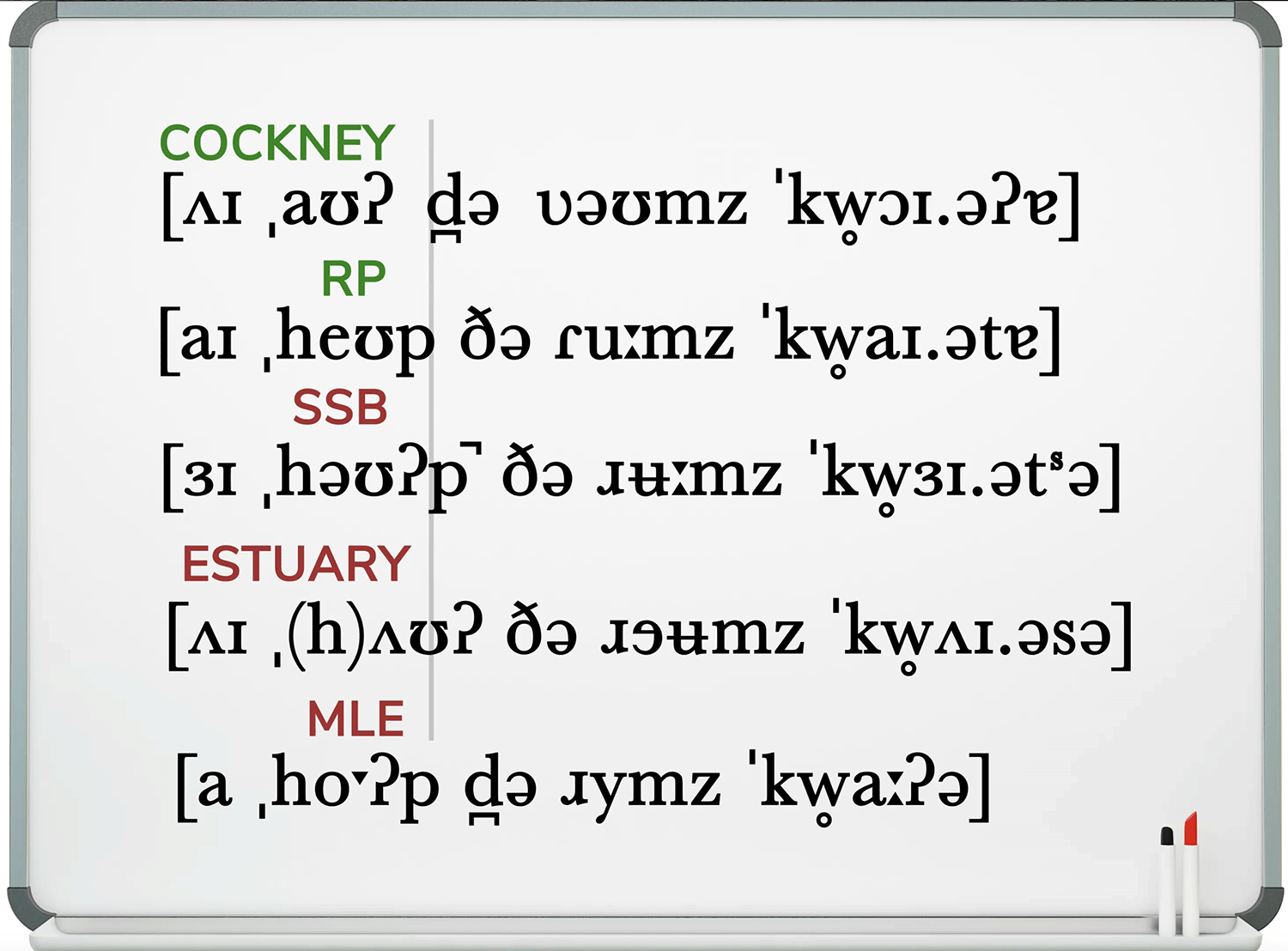
In the video lesson below, I explore these accents using one simple sentence: “I hope the room’s quieter.”
Each of the accents sounds different with H dropping, T Glottalisation, smoothing, and many vowel position variations playing a role.
When you’ve finished the lesson, take the quiz below to test your skills!
Quiz
Quiz Summary
0 of 10 Questions completed
Questions:
Information
You have already completed the quiz before. Hence you can not start it again.
Quiz is loading…
You must sign in or sign up to start the quiz.
You must first complete the following:
Results
Results
0 of 10 Questions answered correctly
Your time:
Time has elapsed
You have reached 0 of 0 point(s), (0)
Earned Point(s): 0 of 0, (0)
0 Essay(s) Pending (Possible Point(s): 0)
Categories
- Not categorized 0%
- 1
- 2
- 3
- 4
- 5
- 6
- 7
- 8
- 9
- 10
- Current
- Review
- Answered
- Correct
- Incorrect
- Question 1 of 10
1. Question
1. Which accent do you hear?
CorrectIncorrectHint
Notice the wide pitch range.
- Question 2 of 10
2. Question
2. Put the pronunciations of WATER in the order you hear them:

 Page load link

View Answers:
CorrectIncorrectQuestion 3 of 103. Question
3. Which 3 accents are generally spoken in working class areas?
CorrectIncorrectQuestion 4 of 104. Question
4. Which accent do you hear?
CorrectIncorrectHint
Notice the quite flat tone, and short vowels.
Question 5 of 105. Question
5. Which speaker has an MLE accent?

 CorrectIncorrectQuestion 6 of 10
6. Question
6. Put the pronunciations of HAT in the order you hear them:




View Answers:
CorrectIncorrectQuestion 7 of 107. Question
7. Put the accents in the order you hear them:
“It’s a little bit difficult these days to see the Arsenal, too pricey.”




View Answers:
CorrectIncorrectQuestion 8 of 108. Question
8. Which two accents are generally spoken by middle and upper class Londoners?
CorrectIncorrectQuestion 9 of 109. Question
9. Which accent do you hear?
CorrectIncorrectQuestion 10 of 1010. Question
10. Put the pronunciations of “I’m a Londoner, through and through” in the order you hear them:

View Answers:
CorrectIncorrect
Comparison Drill





How to Change an Accent – START NOW
In London & Online
Copyright 2008 – 2025 Pronunciation Studio Ltd |
All Rights Reserved | Privacy Policy
We use cookies for usage and preferences - to find out more please see our privacy policyAcceptPrivacy & Cookies PolicyPrivacy Overview
This website uses cookies to improve your experience while you navigate through the website. Out of these, the cookies that are categorized as necessary are stored on your browser as they are essential for the working of basic functionalities of the website. We also use third-party cookies that help us analyze and understand how you use this website. These cookies will be stored in your browser only with your consent. You also have the option to opt-out of these cookies. But opting out of some of these cookies may affect your browsing experience.Necessary cookies are absolutely essential for the website to function properly. This category only includes cookies that ensures basic functionalities and security features of the website. These cookies do not store any personal information.Any cookies that may not be particularly necessary for the website to function and is used specifically to collect user personal data via analytics, ads, other embedded contents are termed as non-necessary cookies. It is mandatory to procure user consent prior to running these cookies on your website.LoginGo to Top